




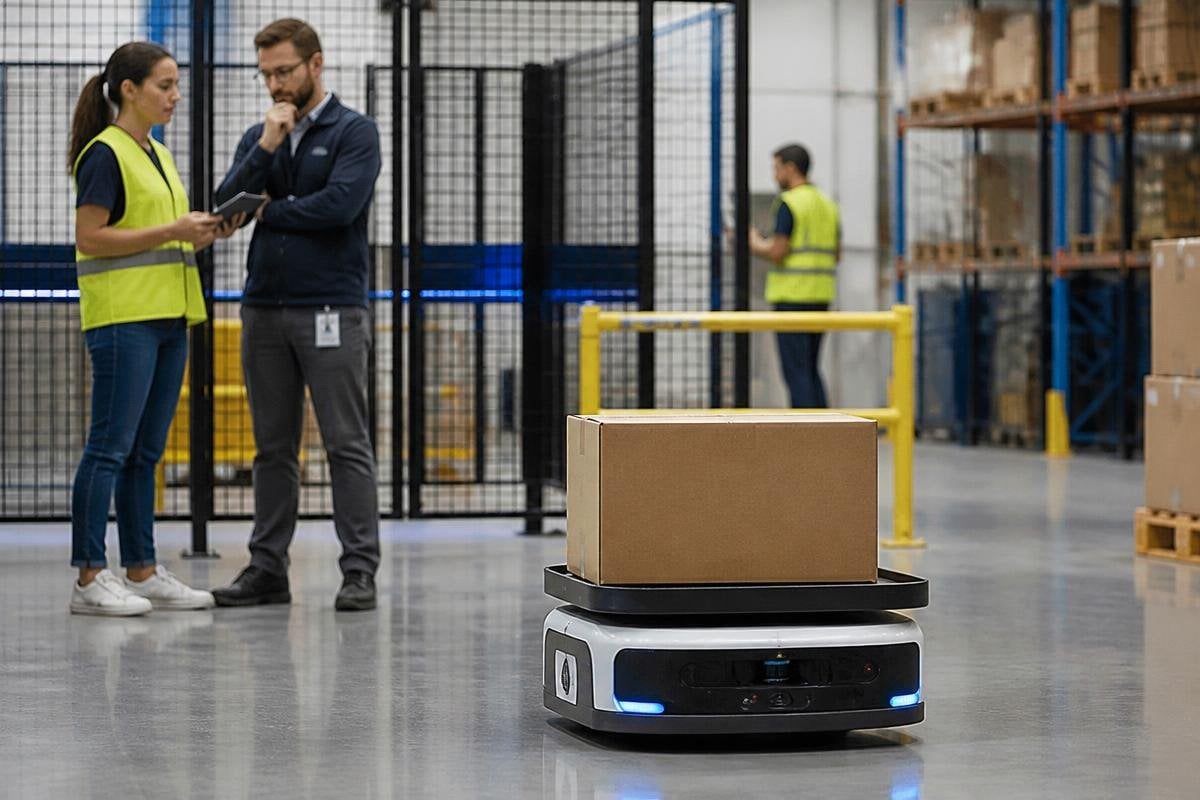
A robot can work well in a test area and still raise hard legal questions once people, property, and public spaces enter the picture. Makers need clear answers on who carries the risk, what proof a machine needs, and how its software handles data.
- Safety: what happens when a sensor misses a person?
- Liability: who pays after a robot causes damage?
- Data: where do video, maps, and worker records go?
Who is responsible when a robot causes harm?
Hardware may come from one company, software from another, and an operating plan from a customer. That split can make responsibility hard to assign after an injury, collision, or damaged shipment.
The maker may face questions about design, warnings, software updates, and known faults. The operator may need to show that staff received proper training and that the machine ran inside its stated limits.
A customer could also face review if they changed the robot’s settings, removed a safety guard, or used it for a job the maker never approved.
The legal answer will depend on the place, the contract, and the facts of the incident. Robot makers still need records that show who made each safety decision and when that decision changed.
That record should cover the robot’s intended task, operating area, speed limits, stop behavior, maintenance plan, and update history. A tidy file cannot prevent an accident, but missing records can make the response harder.
What proof should a safe robot provide?
A product claim needs a test behind it. “The robot avoids people” leaves too much open. A useful safety file would state which sensors the robot uses, what speed it can reach, how close a person may get before it stops, and what happens when a sensor fails.
Those details matter because a robot’s risk changes with its setting. A slow arm behind a fixed guard has a different safety problem from a mobile robot sharing a corridor with workers. A delivery robot on a pavement adds questions about crossings, access, weather, and contact with people who never agreed to work near it.
Makers also need to decide how much of their test method they will publish. Customers need enough detail to check whether a result matches their site. Regulators need a way to inspect the claim without relying on a polished demonstration.
The open question is how regulators will judge systems that change after release. A software update can alter motion, perception, or remote control. The maker needs a process that records the change, checks its effect, and tells the operator what has changed.
What data can the robot collect?
Cameras, microphones, LiDAR, and location systems can collect information about workers, visitors, homes, and nearby buildings. The legal question starts before the robot stores a file: does it need that data, and has the affected person been told?
A maker should explain what the robot records, where the records go, how long they remain available, and who can view them. Access rules matter when a robot sends footage to a remote support team or stores maps on a cloud service.
Data security also affects physical safety. If an outsider takes control of a mobile robot, changes a route, or blocks an emergency command, the result can involve people and equipment. Cybersecurity belongs in the safety review, with clear steps for access, software updates, and incident reports.
That record also matters when regulators ask a maker to explain a robot’s decisions, software updates, and safety limits. Regulation reporting on robots can connect those questions to named systems and company statements before the next section looks at whether makers can explain how their systems work.
Can a robot maker explain its system?
Some systems make decisions through software that is hard for a customer to inspect. A regulator may ask why the robot stopped, moved, rejected an object, or sent a task to a remote operator.
The maker may need logs that connect a decision to sensor input, software state, and human action. Those logs should be readable by the people investigating an incident. A record that only the original engineering team can interpret leaves the customer with little useful evidence.
Worker monitoring adds another concern. A robot that measures task times or records movement can change how a workplace treats people. The maker should state what the system measures and what it cannot judge, so a customer doesn’t mistake machine output for a complete view of human work.
I’d put liability records and update controls ahead of a faster product launch. A robot that reaches customers without those records creates legal work the maker may have to do during the worst possible event.
A pre-launch decision guide
Use these checks before a robot reaches a customer site:
- Define the task: write down the job, area, speed, payload, and people nearby.
- Map the failure: record what the robot does after a sensor, network, motor, or power fault.
- Set ownership: name the party responsible for design, installation, training, maintenance, and updates.
- Control the data: list every sensor, storage location, access group, and deletion rule.
- Keep usable logs: make incident and software records readable without the original development team.
- Review each update: test changes that can affect movement, detection, remote control, or emergency stops.
These checks won’t answer every legal question. They give a maker a clear starting record, which is what regulators, customers, and investigators need when a robot leaves the lab.
The next regulatory test for robot makers will be practical: can the company show how its machine behaves, who controls it, and what changed after release?
