




Ask any chef what limits their menu and they will usually say staff, or space, or the price of protein. Very few say sauce. Yet the bottles behind the wok section quietly decide how many dishes a kitchen can produce, how consistent those dishes taste on a Saturday night, and how much of each pound taken over the counter actually stays in the business.
A well-chosen sauce shelf is a multiplier. Twelve bottles, bought properly, can carry sixty dishes. Twelve bottles bought badly leave you with three tubs of something nobody orders, going sticky at the back of the shelf.
This is the working stock list — the sauces that earn their place in a British kitchen cooking pan-Asian food in 2026, why each one is there, and what to think about when you buy it by the case rather than the bottle.
Your sauce shelf is a commercial decision before it is a flavour one
Two kitchens can run the same menu and post very different gross profit. The difference is rarely the recipe. It is usually the buying.
Retail-format bottles bought from a cash-and-carry cost several times more per litre than catering formats. A kitchen doing forty covers a night on 500ml bottles of light soy is paying a premium for glass and labels it does not need. Equally, an operator who buys a 20kg drum of soy for a site that turns over two litres a month is paying for waste and losing shelf space.
The skill is matching format to throughput — and that is the first thing a good wholesale Oriental sauces supplier should help you do, rather than simply sending a price list.
The twelve
1. Light soy sauce
The backbone. Light soy brings salt and savoury depth without darkening the dish, which is exactly what you want in a stir-fry, a steamed fish, a dipping bowl or a marinade base. If you only get one sauce right, get this one.
Buying note: high-volume kitchens should be on catering formats — 2x8ltr or 1.75-litre pouring bottles — rather than table-size glass. Keep a small case of 150ml bottles separately for front of house.
2. Dark soy sauce
Not a stronger light soy. Dark soy is thicker, slightly sweet from added molasses or caramel, and its job is colour and gloss rather than salt. Red-braised pork, char kway teow, soy eggs and lo mein all depend on it. Use it for finish and use light soy for seasoning; swapping them is the single most common mistake in Western kitchens cooking Chinese food.
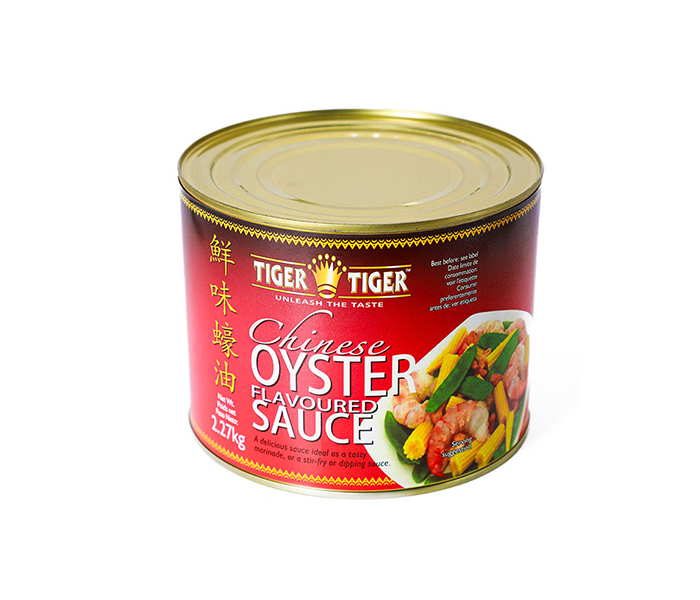
3. Oyster sauce
The umami shortcut. Oyster sauce delivers a savoury roundness that would otherwise take a stockpot and four hours, which is why it is in almost every Cantonese vegetable dish on a UK menu. Premium grades carry more oyster extract and a cleaner finish; standard grades are perfectly good in a heavily seasoned stir-fry.
Buying note: large tins in the 2.2kg range are the sensible unit for busy sites, with 500g squeeze bottles for lower-volume service.
4. Hoisin sauce
Sweet, fermented, faintly five-spiced, and the sauce British diners recognise instantly because it arrives with the crispy duck. Beyond the pancake, it works as a glaze for ribs, a base for a barbecue-style marinade, and a stirred-through finish for noodles.
5. Char siu sauce
Related to hoisin but built for roasting. It caramelises rather than burns, which is what gives char siu pork its lacquered edge. If your menu has any roast meat, a bao, or a rice-box protein, this is the difference between “cooked in sauce” and “properly glazed”.
6. Black bean and garlic sauce
Fermented black soybeans give a pungent, salty, deeply savoury note that cuts through beef, seafood and firm tofu. It is one of the few sauces that reads as authentically Chinese to customers who have started paying attention to regionality — and it needs almost no help beyond garlic, ginger and a wok.
7. Sweet chilli sauce
The highest-turnover sauce in most British kitchens, full stop. It dips, it glazes, it goes in a wrap, it sits on the table. Because volume is so high, this is where format discipline pays: pump-ready 1950ml bottles for the pass, smaller bottles for table service, portion pots for delivery.
8. Sriracha
No longer a novelty. Sriracha has become a default condiment for a generation of UK diners, and the category has fragmented usefully — extra garlic, ginger, green chilli, mayo-blended and genuinely punishing extra-hot versions all now sell as distinct products rather than variations. Stocking two grades of heat lets you cover both the cautious and the confident from the same shelf.
9. Satay and peanut sauce
Malaysian and Indonesian satay sauce, and its smoother peanut cousin, carry skewers, salads, noodle bowls and rice boxes. A ready-made satay base saves grinding and toasting in-house while still allowing you to finish it with coconut milk, lime and chilli so it tastes like yours.
10. Plum sauce
Sweet-sour, fruit-led, and the traditional partner to duck and roast pork. It is also an easy win on the dessert-adjacent end of a menu and in dipping selections where sweet chilli would be too obvious.
11. Rice vinegar and Chinkiang black vinegar
Sauce shelves fail on acidity more often than on salt. Rice vinegar brightens dressings and sushi rice; Chinkiang black vinegar brings a malty, almost balsamic depth that dumpling dips, hot-and-sour soups and Sichuan cold dishes cannot do without. Two bottles, enormous range.
12. Toban djan (chilli bean sauce)
The gateway to Sichuan cooking. Fermented broad beans and chilli give a savoury heat that behaves nothing like a hot sauce — it builds a base rather than adding a top note. Mapo tofu, twice-cooked pork and dan dan noodles all start here, and Sichuan flavours are where a lot of menu growth is currently happening.
Worth adding once the core twelve are in place: kecap manis for Indonesian dishes, tamarind concentrate for pad thai and Southeast Asian sours, XO sauce for a premium seafood dish, and Chu Hou paste for slow-braised beef brisket.
Matching pack format to your operation
| Operation | Typical best fit | Why |
| Single-site takeaway | 500ml–1950ml bottles, cases of 6–12 | Fast turnover, limited storage, needs pump-ready formats at the pass |
| Restaurant with table service | Catering bottles behind the line plus 150ml table bottles | Separates production stock from front-of-house presentation |
| Multi-site group or central kitchen | Tins, 8ltr and 20kg formats, pallet quantities | Lowest cost per litre, fewer deliveries, consistent batch across sites |
| Food manufacturer | Bulk drums, pallet buying | Recipe consistency and predictable input cost |
| Retailer or wholesaler | Retail-size outer cases (e.g. 4x6x245ml) | Shelf-ready, recognisable brands, mixed pallets |
What to actually look for in a supplier
Price per case is the easiest thing to compare and the least useful. The questions that matter over a full year are these.
Does the range have depth? Cooking one credible regional cuisine takes more than a soy sauce. A supplier who stocks Cantonese, Sichuan, Thai, Malaysian and Japanese-facing lines lets you develop a menu without opening five accounts.
Are the brands ones your customers and chefs recognise? Established Asian manufacturers carry credibility with chefs from those culinary traditions, and consistency matters more in sauce than in almost any other input.
Can you buy the same product in more than one format? Growing sites need to step up from bottles to tins to bulk without changing the taste of their food.
Is there allergen and dietary coverage? Gluten-free and vegan alternatives to the core sauces are no longer a niche request.
Can they supply by case and by pallet? Flexibility here is what lets a two-site operator behave like a ten-site one.
JK Foods supplies the full range of sauces to caterers, takeaways, restaurants, retailers and manufacturers across the UK from our Nottingham base, in both case and pallet quantities.
Frequently asked questions
How long do opened sauces last in a commercial kitchen? Follow the manufacturer’s guidance on the label, keep opened bottles refrigerated where instructed, and label them with the date opened. High-turnover kitchens rarely have an issue; low-volume sites should buy smaller formats rather than stretch a large one.
Is it cheaper to make sauces from scratch? Rarely, once labour is costed. Most kitchens get the best of both by buying a quality base and finishing it in-house with aromatics so the final dish is still distinctive.
Can I open a trade account without a large minimum order? Requirements vary by supplier. JK Foods works with independents as well as groups — you can register as a trade customer or get in touch to talk through volumes.
Which sauces should a brand-new site buy first? Light soy, dark soy, oyster sauce, hoisin and sweet chilli will cover the majority of a mainstream pan-Asian menu. Add sriracha, black bean and rice vinegar as the menu widens.
